How to Use AI for Automated PCB Design Rule Checking
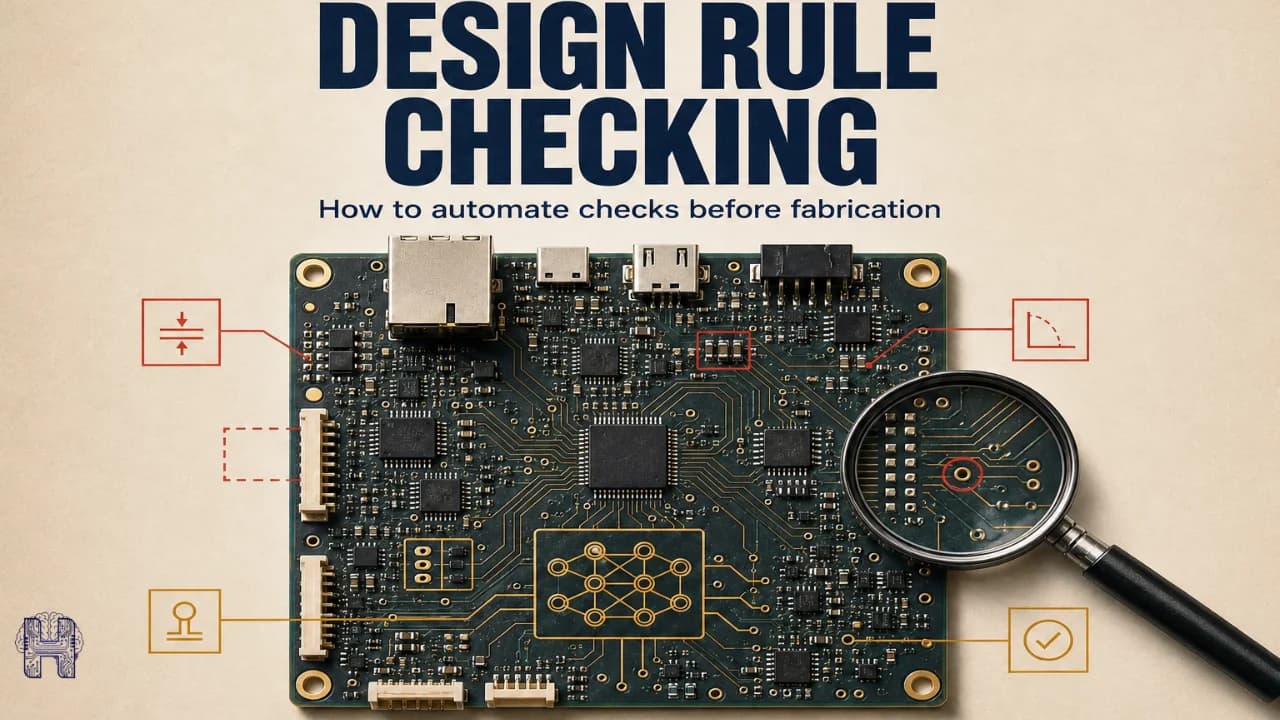
PCB design requires careful verification at every stage. Even a small issue involving trace spacing, component placement, connectivity, or manufacturing constraints can affect the final circuit. This makes design rule checking an essential part of the PCB development process.
Traditional DRC, or design rule check, helps identify predefined violations in a PCB layout. However, modern AI PCB design workflows can add another layer of intelligence by helping designers analyze designs, identify potential issues, and improve the overall PCB design validation process. For beginners and experienced designers alike, platforms such as Helektron.ai are helping make AI-powered electronics design and intelligent design workflows more accessible.
What Is Design Rule Checking (DRC) in PCB Design?
PCB design rule checking is the process of verifying whether a PCB layout follows a set of predefined physical and electrical constraints. A typical PCB DRC checks factors such as trace widths, spacing, clearances, overlapping objects, and other layout requirements. These checks are important because a PCB can appear correct visually while still containing issues that may create manufacturing or performance problems. Effective PCB design verification helps identify these problems before the design moves further toward production. However, traditional DRC mainly checks against rules that have already been defined. This is where AI can support a more intelligent approach to PCB error detection and design analysis.
How Helektron.ai Supports AI-Powered PCB Design
Helektron.ai brings AI into the electronic design workflow by helping users move from an initial idea toward a structured circuit design. Instead of beginning with a complicated manual process, users can describe their requirements and use AI to simplify the early stages of design. As an AI circuit generator and AI schematic generator, Helektron.ai supports a more accessible approach to AI circuit design. Through text-to-circuit AI, users can transform design requirements into a starting point for electronic development. This AI-driven approach supports automated circuit design by reducing the complexity of moving from an idea to a circuit. Once the circuit is developed, designers can continue toward PCB creation, validation, and verification.
How Helektron.ai Transforms PCB Design Validation
Helektron.ai takes a different approach to AI circuit design: instead of flagging errors after the fact, it builds validation directly into the design process. As an AI PCB design tool, Helektron.ai evaluates the layout continuously as it's created, surfacing issues while they're still inexpensive to fix. Here's how the workflow comes together:
1. Text-to-Circuit Generation on Helektron.ai With Helektron.ai's text-to-circuit AI and AI schematic generator, engineers describe a circuit in plain language and get a working schematic in return with design intent already built in, reducing downstream errors before layout even starts.
2. Real-Time PCB Error Detection with Helektron.ai As routing progresses, Helektron.ai runs PCB error detection continuously in the background checking clearances, trace widths, and connectivity against the target fabrication profile at every step, not just at the end.
3. Intelligent PCB Design Validation Beyond simple rule matching, intelligent PCB design on Helektron.ai draws on patterns from thousands of verified boards to catch subtler issues acid traps, thermal risk zones, and signal integrity concerns that rule-based DRC engines often miss.
4. AI-Assisted Circuit Verification Once layout wraps up, AI-assisted circuit verification cross-checks the board against both electrical rules and manufacturability standards, giving engineers one prioritized issue list instead of a scattered error log.
Why Helektron.ai Makes PCB Design Automation More Accessible
Traditional electronic design software can be complex, especially for beginners who need to understand multiple tools before moving from a circuit idea to a PCB. Helektron.ai helps simplify this process through an AI-driven design workflow. With Helektron.ai, users can:
- Start with natural-language requirements: Describe the circuit or electronic project instead of beginning with a complex manual design process.
- Simplify circuit creation: Use AI-assisted workflows to move from an initial idea toward a structured circuit design.
- Generate schematics more efficiently: An AI schematic generator can help users create a starting point for their electronic design.
- Reduce the complexity of traditional workflows: Beginners can approach circuit and PCB development without first mastering multiple complex design tools.
- Support AI-powered electronics design: AI can make the early stages of electronic design more accessible and easier to understand.
- Improve PCB design automation: A more connected workflow can help users move from circuit requirements toward PCB development and verification.
- Focus more on the design itself: By simplifying the starting process, users can spend less time struggling with complex software and more time understanding, reviewing, and developing their designs.
By combining AI electronic design automation, circuit generation, and intelligent design workflows, Helektron.ai helps make the journey from an electronics idea to a structured PCB design more accessible and efficient.
How AI Improves PCB DRC
AI can enhance traditional design rule checking by adding intelligent analysis to the PCB workflow. Instead of relying only on a pass-or-fail DRC design rule check, AI-assisted systems can help analyze design patterns and highlight potential areas that require attention. AI can support:
- Faster PCB error detection
- Identification of unusual layout patterns
- Analysis of circuit connections
- More efficient design reviews
- Improved PCB design validation
- Smarter PCB design automation
This does not mean AI replaces traditional PCB DRC. Instead, AI-powered PCB design can complement established design checks and help designers understand potential issues more efficiently. For further Details contact Team Helektron at +91 87965 06854 Read: Nexus by Helektron: Outperforming the Industry's Top AI Models in 2026 Or visit website helektron.ai