Is AI the Future of Circuit Design?
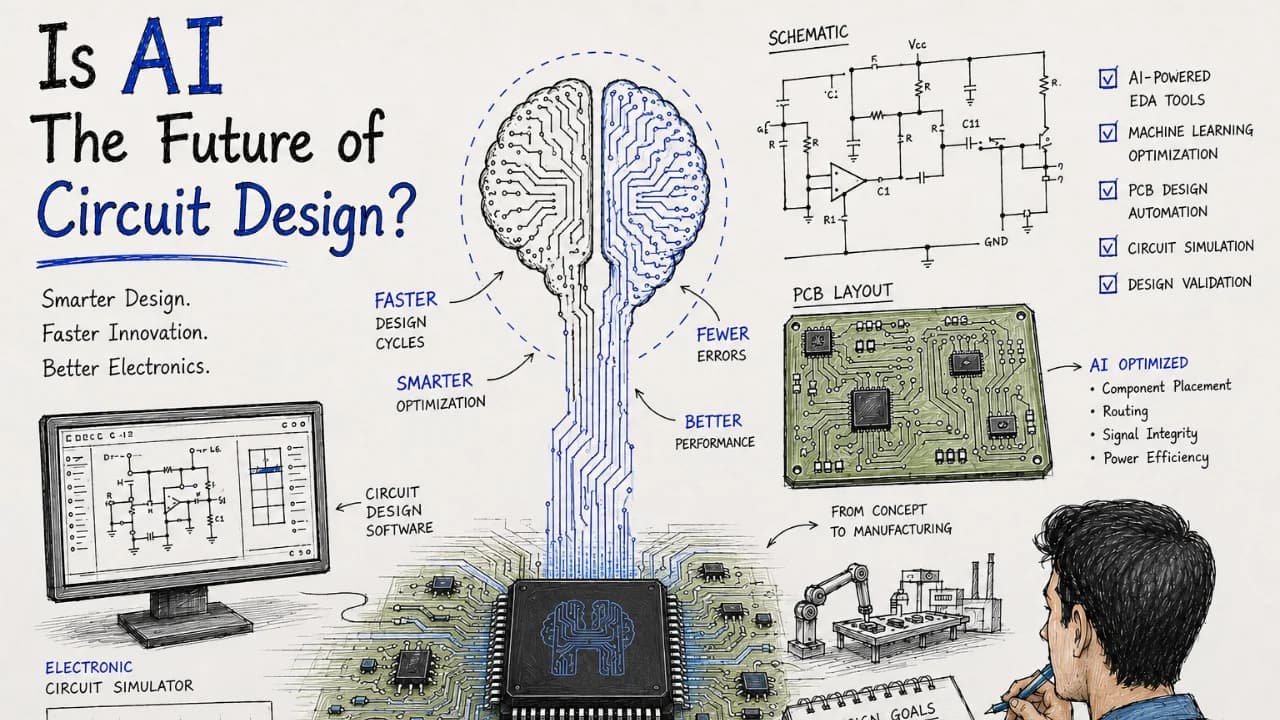
Electronics are getting harder to design, not easier. Boards are denser, chips are more complex, and deadlines keep shrinking. That's exactly why AI in circuit design has moved from buzzword to necessity and why engineers everywhere are asking: is AI the future of electronics design?
What Is AI Circuit Design?
AI circuit design refers to using machine learning algorithms to automate and optimize the process of creating electronic circuits from component placement to routing to verification. Instead of an engineer manually tuning every trace and constraint, AI-powered EDA tools (Electronic Design Automation tools) analyze massive design spaces and suggest or directly generate optimized layouts in a fraction of the time. It's already happening inside electronic design automation (EDA) platforms used by chipmakers and PCB designers today.
Machine learning circuit design tools typically assist with:
- Predicting signal integrity issues before physical testing
- Automating floorplanning and macro placement
- Flagging design rule violations in real time
- Optimizing thermal performance across dense boards
These capabilities are why AI chip design has become a competitive advantage for semiconductor companies racing to hit smaller nodes and tighter power budgets.
AI vs Traditional Circuit Design
The discussion around AI vs traditional circuit design is not about replacing engineers it is about improving productivity. Traditional circuit design depends heavily on manual calculations, repeated testing, and extensive design revisions. While experienced engineers remain essential for critical decisions, AI automates repetitive processes that consume valuable time. Instead of spending hours searching for components or debugging simple issues, engineers can leverage AI to generate optimized solutions and focus on system architecture, validation, and innovation.
Benefits of AI in PCB Design
The growing adoption of AI is driven by several practical advantages.
- Faster Design Process
The biggest benefits of AI in PCB design include dramatically reduced design time. AI can generate initial circuit concepts, recommend suitable components, and automate routing within minutes.
- Improved Design Accuracy
AI continuously learns from previous designs and engineering best practices, helping reduce common design mistakes before manufacturing. This leads to fewer revisions and lower production costs.
- Better Optimization
Modern AI chip design and PCB optimization tools evaluate multiple design possibilities simultaneously, identifying efficient layouts that maximize performance while minimizing space and power consumption.
Is AI the Future of Electronics Design?
The answer is YES.
AI is unlikely to replace experienced engineers. Instead, it will become a powerful engineering partner that handles repetitive tasks, accelerates design iterations, and improves overall efficiency. As AI models become more capable, the future of circuit design will involve closer collaboration between human expertise and intelligent automation. Engineers who embrace AI will be able to build better products faster while maintaining complete control over design decisions. At Helektron.ai, we're building this future by combining AI-driven circuit generation, intelligent PCB workflows, and simulation capabilities into one seamless platform. As AI in circuit design continues to evolve, designers, students, and enterprises will have the tools they need to innovate faster than ever before.
For further Details contact Team Helektron at +91 87965 06854 Read more blogs like How AI Is Changing Circuit Design in 2026? Or visit website helektron.ai